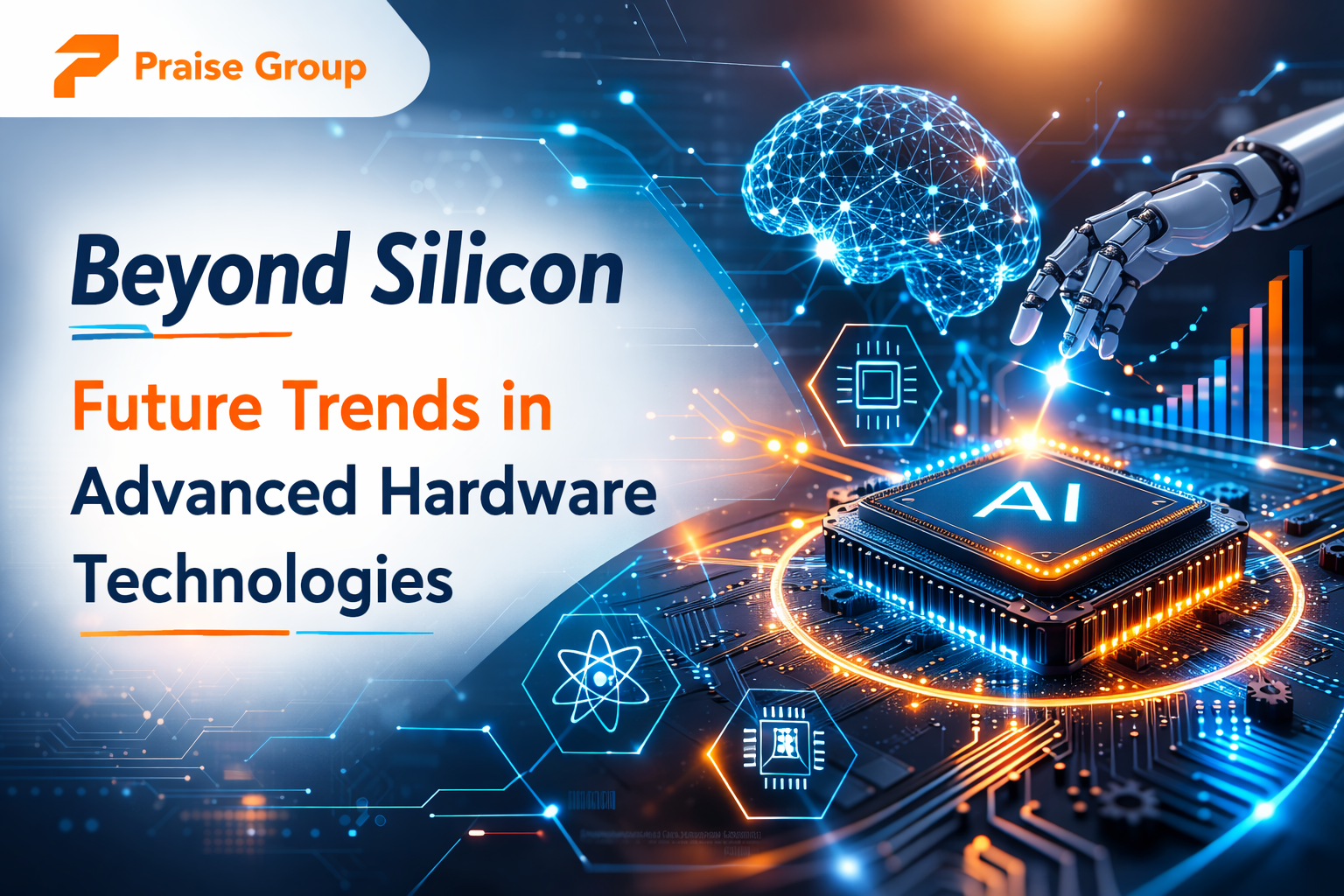



For decades, silicon has powered the digital world. From personal computers to data centers, it has been the foundation of modern computing. But as technology advances and performance demands grow, silicon is gradually approaching its physical limits.
Today, the hardware industry is entering a new era — one that goes beyond traditional silicon-based systems.
From AI-optimized processors to quantum computing breakthroughs, advanced hardware technologies are redefining how industries operate, innovate, and scale.
Why the Industry Is Moving Beyond Silicon
Silicon has served us well. However, shrinking transistor sizes and increasing power consumption are making it harder to push performance further using conventional methods.
To overcome these limitations, researchers and technology leaders are investing in:
- New semiconductor materials
- Three-dimensional chip architectures
- Energy-efficient processing models
- Specialized AI accelerators
This shift signals the beginning of a new hardware revolution — one focused not just on speed, but on smarter and more efficient computing.
AI-Accelerated Chip Design
Artificial Intelligence is no longer just software running on hardware. It is actively shaping the design of hardware itself.
Modern processors are being built specifically for AI workloads. These AI-optimized chips offer:
- Greater parallel processing power
- Lower energy consumption
- Faster machine learning performance
- Improved real-time data processing
Custom AI accelerators are now critical across industries including healthcare, finance, robotics, and autonomous systems. The integration of AI directly into chip architecture is dramatically improving performance efficiency.
Quantum Computing Breakthroughs
Quantum computing represents one of the most transformative advancements in hardware technology.
Unlike traditional computers that rely on binary bits, quantum computers use qubits. This allows them to process complex problems at speeds that were previously unimaginable.
Although still in development, quantum hardware holds enormous potential in areas such as:
- Cryptography
- Drug discovery
- Climate modeling
- Advanced scientific simulations
In the future, hybrid systems combining classical and quantum hardware may become the standard for solving highly complex challenges.
Edge Computing and Distributed Hardware
As IoT devices and connected systems expand globally, relying solely on centralized cloud processing is no longer practical.
Edge computing moves data processing closer to where it is generated. This approach delivers:
- Lower latency
- Greater data security
- Faster real-time responses
- Improved operational efficiency
Advanced chip designs are now integrating edge capabilities directly into embedded systems, enabling smarter and more responsive devices.
Robotics and Intelligent Automation
Modern robotics requires hardware capable of processing massive amounts of sensor data instantly.
Innovations in neuromorphic chips, adaptive circuits, and advanced microprocessors are enabling robots to:
- Learn from their environment
- Adapt to changing conditions
- Operate autonomously with minimal delay
These advancements are transforming industries such as manufacturing, logistics, healthcare, and industrial automation.
Sustainable and Energy-Efficient Technologies
The future of hardware is not only about performance — it is also about sustainability.
Energy-efficient processors, improved cooling technologies, and environmentally conscious design strategies are becoming essential priorities.
As global demand for computing power rises, sustainability will play a defining role in competitive advantage and long-term growth.
The Road Ahead
Moving beyond silicon does not mean abandoning it entirely. Instead, the future lies in combining multiple innovations, including:
- Advanced semiconductor materials
- AI-optimized chipsets
- Quantum integration
- Edge-based architectures
- Sustainable engineering solutions
Organizations that embrace these next-generation hardware technologies will be positioned to lead the next wave of digital transformation.
Final Thoughts
The future of advanced hardware technologies is not simply about making chips faster. It is about building smarter architectures, improving efficiency, and designing systems ready for intelligent automation.
As innovation accelerates, we are entering a post-silicon era where adaptability, performance, and intelligence define success.
The hardware revolution has begun — and it is only getting started.


Leave a reply